










The 72-Hour Sprint: Mastering Frontline Readiness
In the used car business, time isn’t just money—it is the single biggest factor determining your gross profit. Every day a vehicle sits in the “reconditioning queue” is a day it is losing value, accumulating holding costs, and missing out on potential buyers.
The “72-Hour Sprint” is the industry gold standard for Time-to-Line (T2L): the process of taking a car from “just acquired” to “retail-ready” and online within three days. If you can master this speed, you aren’t just selling cars; you are turning your inventory faster than your competitors, keeping your capital liquid, and ensuring your showroom is always fresh.
The Anatomy of the 72-Hour Sprint
To hit that 72-hour mark, you must stop viewing reconditioning as a chaotic “fix-it” phase and start treating it as a manufacturing assembly line.
Phase 1: The First 24 Hours (Intake & Triage)
- Rapid Inspection: Do not wait for a full workshop appointment. Perform a “triage” inspection the moment the car lands. Is it a winner or a dud? If the vehicle needs major mechanical work that will take weeks, do not tie up your cash. Move it to wholesale immediately.
- Work Order Lockdown: The used car manager must approve the “must-do” list instantly. Don’t let a work order sit on a desk waiting for a signature. Use a simple digital checklist or a shared WhatsApp group to green-light the work.
- Documentation: Start the NATIS and dealer-stocking process immediately. Paperwork bottlenecks are the #1 reason cars sit unlisted.
Phase 2: The Next 24 Hours (The “Heavy Lifting”)
- Concurrent Workflow: Don’t wait for the mechanic to finish before the detailers start. If the engine work is minor, have your detailing team working on the interior/exterior at the same time.
- The “Retail-Ready” Standard: A common mistake is “over-conditioning.” You are not restoring a vintage classic; you are preparing a retail unit. Focus on safety (brakes, tyres, fluids) and appearance (valet, scratch removal, paint correction). If it doesn’t add value to the customer’s purchase decision, don’t do it.
Phase 3: The Final 24 Hours (Merchandising)
- Photography/Videography: The moment the car comes off the detail bay, it should hit the photo studio or the showroom floor. High-quality, consistent photography is non-negotiable.
- Digital Launch: Your listing should go live before the car is even parked on the front line. In 2026, the internet is your primary showroom. If the car is cleaned and priced, it should be on Car Listing immediately.
Why Speed is Your Greatest Profit Protector
- Depreciation is Real: Every day a car sits, it depreciates. If your holding cost is R40 per day, a 20-day delay costs you R800. If you do this for 100 cars a year, you are losing R80,000 in pure profit just by being slow.
- Inventory Turn: Every 3 days you shave off your T2L equals one extra inventory “turn” per year. More turns = more profit, more often.
- The “Freshness” Advantage: Buyers on Car Listing sort by “Newest.” When you list a car within 72 hours, you capture the high-intent buyers who are scanning for the latest stock. You are literally the first one they see.
Pro-Tips for Implementation
- Stop the “Finger-Pointing”: If your workshop blames the detailers and the detailers blame the photographer, you have a culture problem. Appoint one person as the “Recon Manager” who owns the 72-hour clock.
- Vendor Partnerships: Don’t do everything in-house if you aren’t efficient at it. If your in-house valet team is always backed up, outsource the deep-cleaning to a professional mobile detailer who can come to your lot and finish a car in 4 hours.
- Use a “Red Flag” Timer: If a car has been in recon for more than 72 hours, it gets a “Red Flag” status. The manager must physically walk to that car and ask: “Why is this still here?”
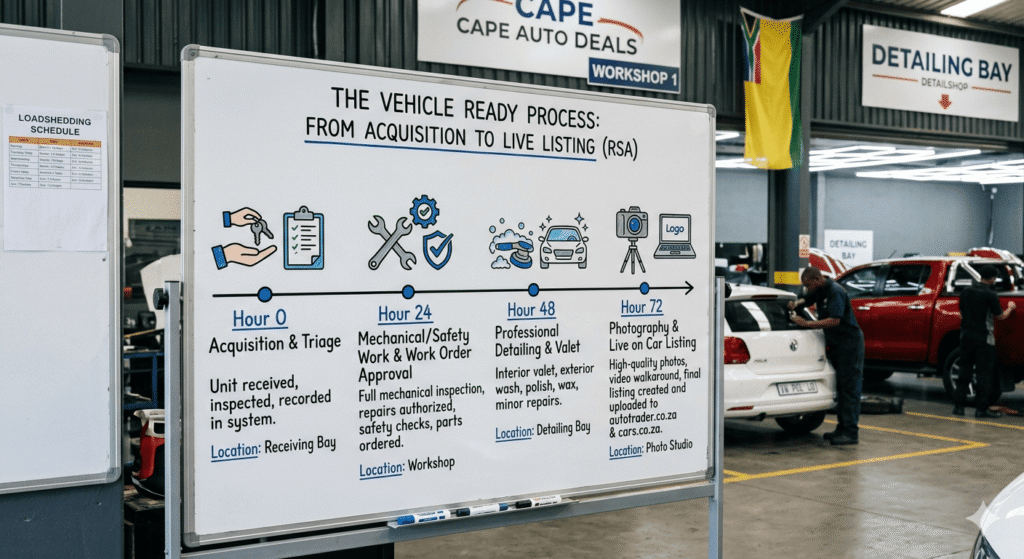
The 72-Hour Sprint: From “Acquired” to “Sold” starts with speed.
The Bottom Line
“Frontline readiness” is a mindset. When you commit to a 72-hour sprint, you stop treating cars as “inventory to be stored” and start treating them as “assets to be liquidated.”
You now have the full series of strategies to professionalize your dealership. You have the digital tools, the safety protocols, the sourcing strategy, and the operational speed to dominate your local market. What would you like to focus on next?