





















Budgeting for the Unexpected: The 10% Maintenance Rule
The “Sticker Price” Trap
When you find a car you love, it’s easy to focus solely on the “sticker price.” You’ve calculated your finance, checked your insurance, and mapped out your fuel costs. But there is one final, critical step that separates the prepared buyer from the stressed-out owner: The 10% Maintenance Buffer.
No matter how thorough the inspection, you are buying a machine with a history. A set of tyres might look fine at the dealership but wear out after six months of highway driving. A battery might decide to give up the ghost in the middle of a cold Gauteng winter. If you haven’t budgeted for these “oops” moments, a small repair can quickly become a massive financial headache.
Understanding Your “Peace of Mind”
In South Africa, “peace of mind” isn’t just a marketing slogan; it’s backed by law. When buying from a registered dealership, you are protected by the Consumer Protection Act (CPA).
- The 6-Month Implied Warranty: Under the CPA, you have a statutory right to a 6-month warranty on a used vehicle from a dealership. If a significant defect (that wasn’t disclosed) emerges within 6 months, the dealer is legally obligated to repair, replace, or refund the vehicle. “Voetstoots” clauses in dealer contracts cannot override your CPA rights.
- Dealer-Offered Warranties: Many dealerships (like WeBuyCars or local independent specialists) offer an additional 3 to 6-month (or longer) “Mechanical Breakdown Warranty.” These are often insurance-backed policies that cover major components like the engine, gearbox, and electrical systems.
- The Difference: While the CPA protects you against latent defects that were there at the time of sale, a mechanical warranty is designed to cover future mechanical failures. Always ask: “Is this an insurance-backed warranty, and what specific mechanical parts are covered?”
Why the 10% Buffer Still Matters
Even with a warranty, you still need a buffer. Here is why:
- The “Excluded” Items: Warranties (and the CPA) rarely cover “wear and tear.” This includes tyres, brake pads, wiper blades, clutches, and light bulbs. When these naturally reach their end-of-life, the cost is 100% on you.
- Preventative Maintenance: Use your 10% buffer to do a “peace-of-mind” service the moment you get the keys—change the oil, the filters, and the plugs. Don’t wait for the car to tell you it needs a service; take the initiative.
- The “Oops” Fund: If a non-covered sensor fails, you won’t have to raid your rent money or put the repair on a high-interest credit card. You’ll simply dip into your buffer and get it fixed.
A Golden Rule: Don’t Finance the Buffer
Do not add this 10% to your car loan. If you finance your maintenance budget, you are paying interest on that money for 60 to 72 months. Keep this money in a separate, high-interest savings account. It stays yours, it earns interest, and it is there for you—not the bank—when you need it.
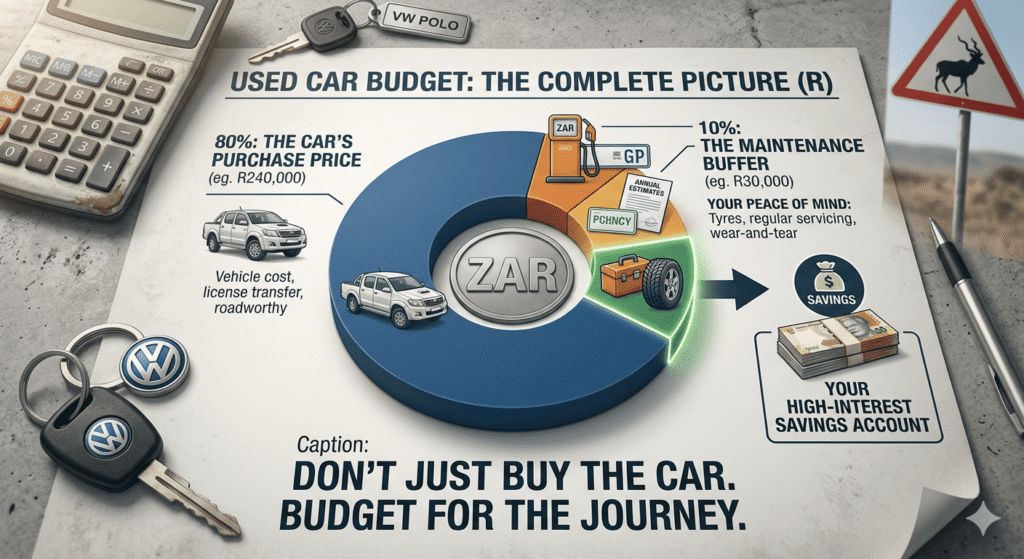
Don’t just buy the car. Budget for the journey.
Your Roadmap to a Smarter Sale
Over these articles, we’ve covered the entire lifecycle of your automotive journey: from building a Permanent Digital Anchor for your dealership to mastering WhatsApp CRM, navigating the bakkie market, and ensuring you protect your identity and your wallet.
You now have a complete toolkit:
- For the Dealer: You have a strategy to scale, a system to track leads, and a professional digital showroom that works 24/7.
- For the Buyer: You have the knowledge to avoid scams, the confidence to demand your CPA rights, and the financial strategy to make sure your new car remains an asset, not a burden.
We are here to help you execute these strategies. Would you like to start by generating the content for your first “Verified” listing, or shall we draft a template for your dealership’s “WhatsApp Business” Quick Replies?